

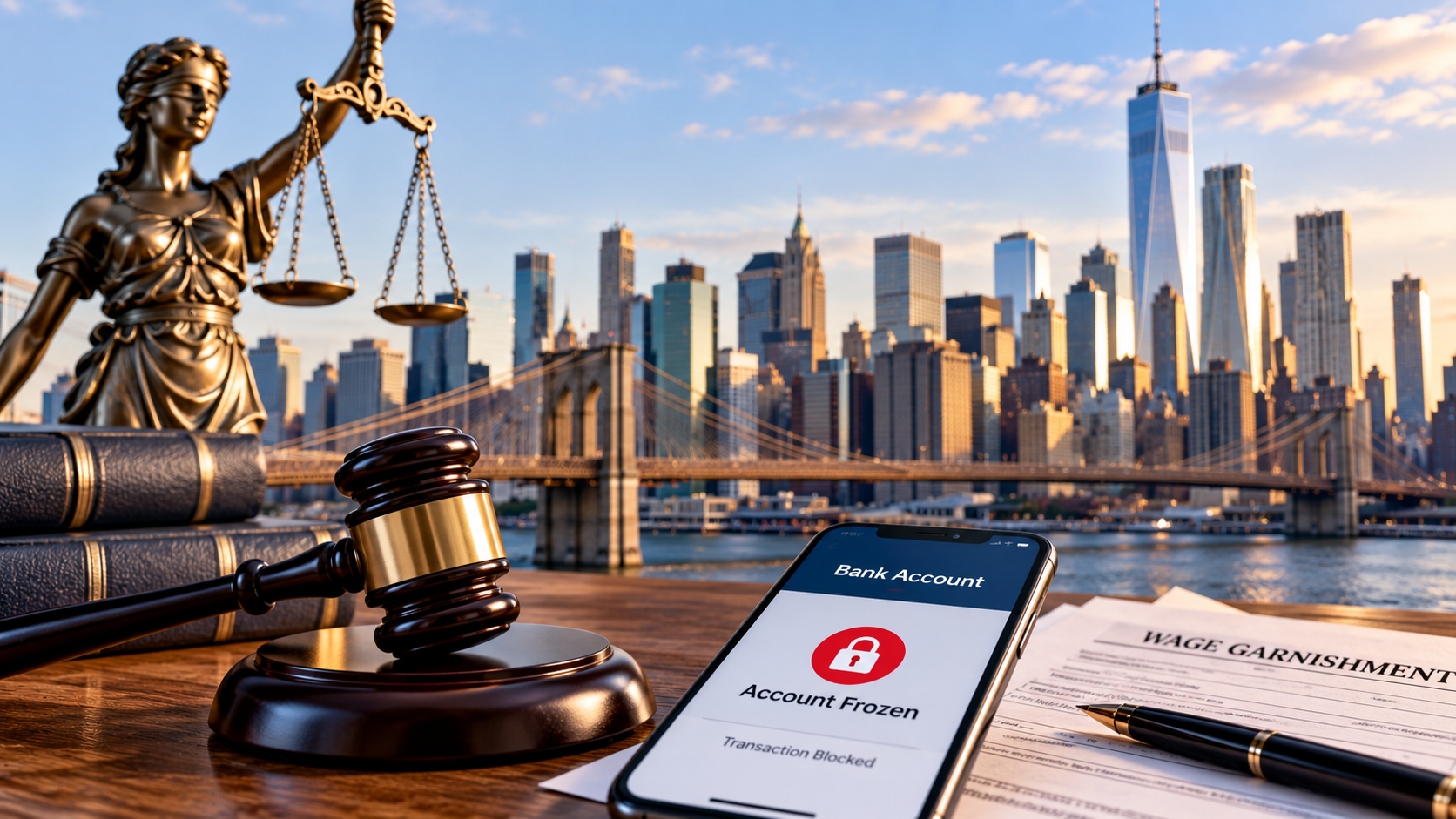
Can a Creditor Freeze Your Bank Account or Garnish Your Wages in New York in 2026?
Last updated: October 6, 2026
This article provides general educational information about New York debt collection and bankruptcy issues. It is not legal advice and does not create an attorney-client relationship. Laws, exemptions, minimum-wage rates, procedures, and court interpretations may change, and the rules that apply depend on the particular judgment, debt, income, account, and procedural circumstances.
Receiving notice that a bank account has been restrained or that money may be taken from a paycheck can create an immediate financial problem.
For many ordinary consumer debts, a creditor generally must first obtain a court judgment before using New York post-judgment enforcement procedures. Other obligations—including some taxes, child support, government debts, and federal student loans—may be governed by different collection rules.
Even after a judgment has been entered, New York and federal law provide protections that may apply to certain wages, bank-account balances, government benefits, and other exempt income.
Understanding these protections is important because a bank restraint or income execution does not necessarily mean that every dollar in an account or paycheck is legally available to a creditor.
Can a Creditor Freeze a Bank Account in New York?
A judgment creditor may use enforcement procedures authorized under New York law to attempt to collect a judgment.
One method involves serving a restraining notice on a bank or other financial institution.
When a valid restraining notice applies to a judgment debtor’s property, the financial institution may be required to restrict access to qualifying funds.
However, a restrained account does not necessarily mean that all of the money in the account can legally be taken by the creditor.
New York law provides protections for certain funds and procedures intended to protect property that may be exempt from judgment enforcement.
What Is a Restraining Notice?
A restraining notice is a legal enforcement mechanism that may be used after a judgment has been entered.
Under Article 52 of New York’s Civil Practice Law and Rules, a judgment creditor may use various procedures to identify and enforce against property belonging to a judgment debtor.
When a financial institution receives an applicable restraining notice, it may be required to restrict access to property covered by that notice.
There is an important distinction between a bank restraint and a creditor’s ultimate legal right to receive particular funds.
The fact that money has been restrained does not, by itself, establish whether those funds are exempt or legally available to satisfy a judgment.
How Much Money May Be Protected in a New York Bank Account?
New York’s Exempt Income Protection Act (EIPA) provides protections intended to preserve certain funds in bank accounts from judgment enforcement.
Some statutory protections are calculated using the applicable New York minimum wage. Because minimum-wage rates can change, the corresponding exemption amounts can also change.
As of 2026, New York’s minimum wage is:
- $17.00 per hour in New York City, Long Island, and Westchester County; and
- $16.00 per hour in the remainder of New York State.
Based on those wage rates and the applicable statutory calculation, certain accounts may be entitled to protections corresponding to approximately:
- $4,080 in New York City, Long Island, and Westchester County; and
- $3,840 in other parts of New York State.
These figures are provided for general educational purposes and should not be treated as a determination of the amount protected in a particular account.
The amount and availability of protection depend on current law and the circumstances of the account, including potentially the source of funds and the particular enforcement procedure involved.
Are Social Security and Other Benefits Protected?
Some income and benefits may be exempt from judgment enforcement or subject to special protections under federal or New York law.
Depending on the applicable law and circumstances, these may include certain payments associated with:
- Social Security;
- Supplemental Security Income (SSI);
- disability benefits;
- unemployment benefits;
- public assistance;
- workers’ compensation;
- certain pension or retirement benefits;
- child support or spousal support; and
- other legally protected income.
The scope of protection varies by benefit, source, deposit history, and enforcement procedure.
Federal rules also provide specific protections for certain federal benefit payments deposited directly into bank accounts.
A bank restraint therefore does not, by itself, establish whether particular funds are exempt or ultimately available to a judgment creditor.
Can a Creditor Garnish Your Wages in New York?
Under qualifying circumstances, a judgment creditor may pursue an income execution against a judgment debtor’s earnings.
New York and federal law limit the amount that may be withheld.
The permissible amount is fact-specific and may depend on factors including:
- disposable earnings;
- the applicable minimum wage;
- statutory income thresholds;
- frequency of payment;
- applicable deductions;
- support obligations; and
- federal garnishment limitations.
The calculation can therefore be more complicated than applying a single percentage to a paycheck.
This article does not provide a garnishment or income-execution calculation for any particular employee, paycheck, or debt.
Are Low-Income Workers Protected From Wage Garnishment?
New York law provides protections that depend in part on disposable earnings and the applicable minimum wage.
CPLR § 5231 establishes limitations on income executions, while federal law imposes additional restrictions on garnishment of disposable earnings.
Because New York’s minimum wage varies by location, the applicable calculation may also depend on where the employee works.
As of 2026, the minimum wage is $17.00 per hour in New York City, Long Island, and Westchester County and $16.00 per hour elsewhere in New York State.
Different rules may apply to obligations such as child support, certain taxes, federal student loans, and other debts governed by specialized enforcement statutes.
Does a Creditor Need a Court Judgment?
For many ordinary consumer debts—including many credit-card debts, personal loans, and collection accounts—a creditor generally must obtain a judgment before using New York post-judgment enforcement procedures.
A judgment may permit a creditor to pursue enforcement mechanisms including:
- bank-account restraints;
- property executions;
- income executions; and
- other remedies authorized by law.
However, this general rule does not apply uniformly to every type of debt.
Some taxes, child-support obligations, government debts, federal student loans, and other specialized obligations may be subject to different collection procedures.
What If You Never Knew About the Lawsuit?
Some consumers first learn that a lawsuit occurred after a bank account is restrained or collection against wages begins.
That does not necessarily determine whether the underlying judgment or enforcement procedure can be challenged.
Depending on the circumstances, legal issues may involve service of process, notice, the underlying judgment, available defenses, or procedures for requesting that a court vacate or modify a judgment.
Whether relief is available depends on the facts and procedural history of the particular case.
Deadlines may apply, and this article cannot determine whether a specific judgment or enforcement action can be challenged.
How a Bankruptcy Filing May Affect Collection Activity
A bankruptcy filing may affect collection activity through the federal automatic stay under 11 U.S.C. § 362.
The automatic stay can restrict many collection activities after a bankruptcy petition is filed.
However, whether a stay applies, its scope, and whether it affects an existing restraint or income execution depend on the circumstances of the case and applicable statutory exceptions.
Factors can include:
- the type of debt;
- prior bankruptcy filings;
- the status of the collection process;
- the debtor’s assets and exemptions; and
- statutory exceptions to the automatic stay.
Bankruptcy should therefore not be viewed simply as an automatic mechanism for stopping every collection action.
Whether bankruptcy is appropriate requires a broader evaluation of the individual’s financial circumstances.
What Happens to Money Frozen Before Bankruptcy?
A bankruptcy filing may not undo a restraint, turnover, or transfer that occurred before filing.
The result can depend on the facts, applicable exemptions, the type of debt, when the restraint or transfer occurred, and the procedural status of the collection action.
Accordingly, filing bankruptcy should not be assumed automatically to release or return money that was restrained or transferred before the bankruptcy petition was filed.
Timing can be legally significant.
Documents That May Be Relevant to a Bank Restraint or Income Execution
Documents that may be relevant when evaluating a bank restraint or income execution can include:
- the judgment;
- restraining notice;
- income or property execution;
- exemption notices;
- bank correspondence;
- papers from the underlying lawsuit; and
- records showing the source of funds deposited into the account.
Deadlines may apply to particular enforcement proceedings, and this article cannot evaluate the circumstances of a specific case.
Consumers also should not move, conceal, or transfer assets to evade lawful collection based on information in this article. Such conduct may create additional legal issues.
Questions About Debt Collection or Bankruptcy in New York?
Individuals with questions about a collection lawsuit, judgment, bank restraint, wage execution, or bankruptcy may contact Pagán López Law for information about scheduling a consultation.
Pagán López Law
96-04 Northern Boulevard
Corona, NY 11368
Phone: (646) 216-8881
WhatsApp: (347) 434-3041
Email: info@paganlopezlaw.com
Contacting the firm does not create an attorney-client relationship, and the firm cannot accept confidential or time-sensitive information unless it confirms that it can undertake representation.
Debt Relief Agency Notice
Pagán López Law is a debt relief agency. The firm helps people file for bankruptcy relief under the Bankruptcy Code where appropriate.
Attorney Advertising
This article is provided for general informational and educational purposes only and does not constitute legal advice. New York and federal laws, exemptions, minimum-wage rates, procedures, and court interpretations may change, and the information may not apply to every case.
Reading this article, contacting Pagán López Law, or sending information by telephone, email, WhatsApp, website form, or social media does not create an attorney-client relationship. Representation begins only after the firm completes any required intake and conflict review and the attorney and client enter into an engagement agreement.
Please do not send confidential, time-sensitive information or case documents through email, WhatsApp, a website form, or social media unless and until the firm confirms that it can accept the representation.seo