

E-Bike Accidents in New York City: Who May Be Liable for an Injury?
Last updated: October 6, 2026
Attorney Advertising. This article provides general educational information only and is not legal advice. It does not create an attorney-client relationship and should not be relied upon to determine rights, obligations, insurance coverage, or deadlines in a specific matter. Laws, deadlines, coverage issues, and court interpretations may vary and may change. Deadlines may be short.
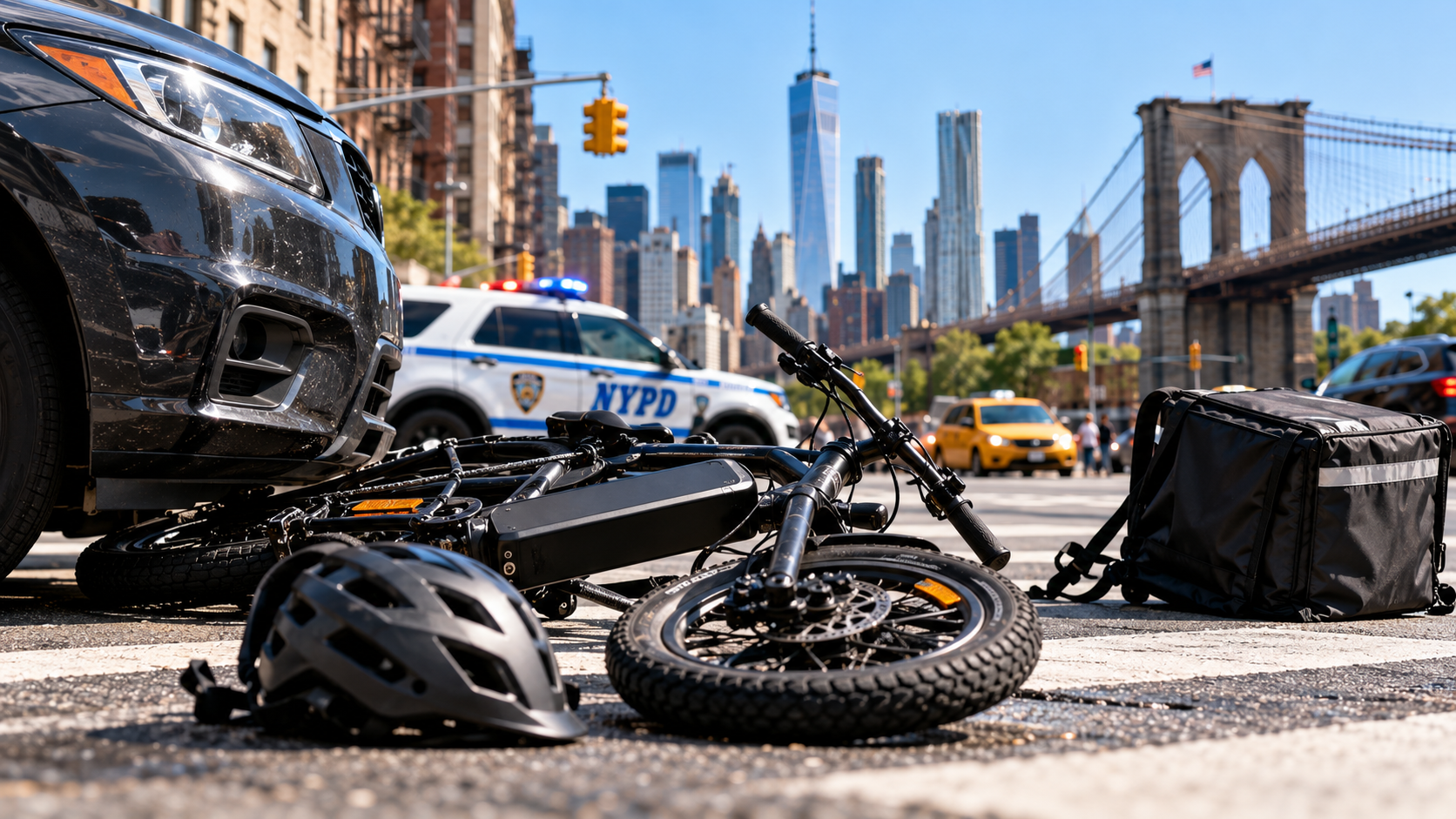
Electric bicycles have become a common part of transportation and delivery work throughout New York City. Their increased use also creates difficult legal questions when an e-bike collides with a car, truck, pedestrian, another cyclist, or another e-bike.
Determining responsibility after an e-bike accident is not always as simple as identifying who struck whom.
Depending on the circumstances, potential legal issues may involve driver negligence, cyclist conduct, traffic laws, insurance coverage, an employer or delivery company, a defective bicycle or component, or a dangerous roadway condition.
Who May Be Liable for an E-Bike Accident in New York?
Liability depends on how the accident occurred.
A person or entity that may potentially bear responsibility could include:
- a negligent car or truck driver;
- an e-bike rider;
- another cyclist;
- an employer in circumstances where an employee was acting within the scope of employment;
- a manufacturer or other responsible party in a product-related claim; or
- a government entity responsible for a dangerous roadway condition, when applicable legal requirements are satisfied.
More than one party may potentially share responsibility for the same accident.
Determining liability generally requires examining the specific facts, evidence, legal duties, causation, defenses, and applicable law rather than assuming that one category of road user is automatically responsible.
When a Driver May Be Liable for an E-Bike Collision
A motorist may potentially be liable when negligent driving causes or contributes to an e-bike collision.
Relevant conduct may include circumstances involving:
- speeding;
- failure to yield;
- unsafe turns;
- distracted driving;
- following too closely;
- failure to observe traffic conditions;
- opening a vehicle door into the path of a cyclist; or
- other violations or negligent conduct.
Whether a driver was negligent depends on the evidence and circumstances surrounding the collision.
A traffic violation may be relevant to a negligence analysis, but liability should not be assumed solely from the fact that a collision occurred.
When an E-Bike Rider’s Conduct May Be Relevant to Fault
E-bike riders must comply with applicable New York traffic laws and New York City rules.
Depending on the circumstances, conduct such as disregarding traffic signals, failing to yield when legally required, traveling in prohibited areas, or operating an e-bike in an unsafe manner may become relevant when determining fault.
However, evidence that an injured person contributed to an accident does not necessarily end a New York personal injury claim.
What If More Than One Person Was at Fault?
Under NY CLS CPLR § 1411, an injured person’s contributory negligence does not necessarily bar recovery, but may reduce damages in proportion to culpable conduct.
How fault is allocated depends on the evidence and applicable law.
If an injured person is ultimately determined to bear part of the responsibility for an accident, that percentage may affect the damages recoverable.
The actual allocation of fault is fact-specific and should not be assumed from a hypothetical example.
When an E-Bike Accident Involves a Pedestrian
An e-bike collision involving a pedestrian can raise different factual and legal questions.
The investigation may consider matters such as:
- where the collision occurred;
- traffic signals;
- pedestrian right-of-way;
- bicycle or e-bike lane restrictions;
- speed;
- visibility;
- witness statements; and
- video evidence.
Depending on the facts and applicable law, an injured pedestrian may have a potential claim against one or more parties.
Whether a viable claim exists depends on the evidence, legal duties, causation, damages, defenses, and available parties.
Identifying an available insurance policy or financially responsible party may also be more complicated than in a conventional motor-vehicle accident.
When a Motor Vehicle Hits an E-Bike Rider
When a motor vehicle collides with an e-bike, both liability and insurance issues may require careful analysis.
The circumstances may involve the driver’s automobile liability insurance, New York insurance law, the legal classification and characteristics of the e-bike involved, and other potentially available insurance coverage.
Insurance treatment should not be assumed to be identical in every e-bike collision.
Whether a particular insurance policy or statutory benefit applies depends on the facts, vehicles involved, policy language, and applicable New York law.
No-Fault Questions After an E-Bike Collision
New York no-fault coverage questions can be fact- and policy-specific.
Eligibility may depend on, among other things, the circumstances of the collision, the involved vehicles, available coverage, policy terms, and applicable law.
This article does not determine whether no-fault benefits apply in any particular e-bike accident.
An injured person should not assume either that no-fault coverage automatically applies or that it is automatically unavailable.
E-Bike Accidents Involving Delivery Workers
Delivery-related e-bike accidents can raise additional liability and insurance questions.
A delivery platform’s potential responsibility, if any, depends on the particular facts, contractual and operational relationships, the rider’s status, the nature and scope of the work, insurance, and applicable law.
The use of a delivery platform alone does not determine liability.
Determining whether an employer, business, platform, rider, or another entity may bear responsibility requires a fact-specific legal analysis.
When an E-Bike or Component May Be Defective
Some accidents may involve an alleged mechanical or product failure rather than—or in addition to—operator negligence.
Potential issues could involve components such as:
- brakes;
- batteries;
- electrical systems;
- frames;
- tires;
- throttles; or
- other bicycle components.
A product-related claim may be considered only where the facts and evidence support it.
The existence of a malfunction or component failure, by itself, does not establish a defect, causation, or liability.
When a Dangerous Street or Road Condition May Have Contributed
Some e-bike accidents may involve allegations concerning potholes, roadway defects, construction zones, signs, traffic-control devices, or other street conditions.
Claims involving governmental entities may be subject to special notice requirements and significantly shorter deadlines than some other personal injury claims.
For some claims against the City of New York, a Notice of Claim may be required within 90 days, but deadlines, exceptions, defendants, and procedural requirements can vary.
Do not rely on the 90-day period to determine the deadline for a particular matter. The applicable requirements depend on the specific public entity, claim, and circumstances.
How Long Do You Have to File an E-Bike Accident Lawsuit in New York?
New York statutes of limitations vary according to the type of claim, defendant, and circumstances involved.
Some negligence claims may be subject to a three-year limitations period under NY CLS CPLR § 214, but other claims may have different or substantially shorter deadlines.
Claims involving governmental entities, for example, may involve separate notice requirements and shorter time periods.
Do not rely on a general limitations period to calculate a deadline for a particular matter.
Evidence That May Be Relevant After an E-Bike Accident
Evidence may be relevant in some cases and may not remain available indefinitely. The information needed and appropriate next steps depend on the circumstances and applicable law.
Depending on the accident, potentially relevant evidence can include:
- photographs or video of the accident scene;
- police or incident reports;
- witness information;
- surveillance footage;
- dash-camera footage;
- photographs of the vehicles or e-bike;
- medical records;
- insurance information;
- delivery or app records, where applicable; and
- records concerning the condition of the roadway or bicycle.
The evidence necessary in a particular case depends on the nature of the accident and the legal claims involved.
What Compensation May Be Available After an E-Bike Accident?
Potentially recoverable damages, if supported by the evidence and permitted by applicable law, may include some or all of the following:
- medical expenses;
- lost earnings;
- diminished earning capacity;
- pain and suffering;
- rehabilitation expenses; and
- other legally recoverable losses.
The available categories and amount of damages vary by claim and circumstances.
No particular result or amount of compensation can be predicted based solely on the type of accident or injury.
Questions About an E-Bike Accident in New York?
Individuals with questions about an e-bike, bicycle, pedestrian, car, or truck accident in New York may contact Pagán López Law to request information about scheduling a consultation.
Pagán López Law
96-04 Northern Boulevard
Corona, NY 11368
Phone: (646) 216-8881
WhatsApp: (347) 434-3041
Email: info@paganlopezlaw.com
Contacting the firm does not create an attorney-client relationship. The firm may be unable to accept a matter unless and until it completes its review and confirms in writing that it will undertake the representation and the parties enter into a written engagement agreement.
Do not send confidential, privileged, original, or time-sensitive information or documents through email, WhatsApp, website forms, or social media. Sending information does not create an attorney-client relationship. Send such information only if and as the firm specifically instructs after it has agreed in writing to represent you.
Attorney Advertising
This article provides general educational information only and is not legal advice. It does not create an attorney-client relationship and should not be relied upon to determine rights, obligations, insurance coverage, or deadlines in a specific matter. Laws, deadlines, coverage issues, and court interpretations may vary and may change.
No attorney-client relationship exists unless and until Pagán López Law confirms in writing that it will undertake the representation and the parties enter into a written engagement agreement.