


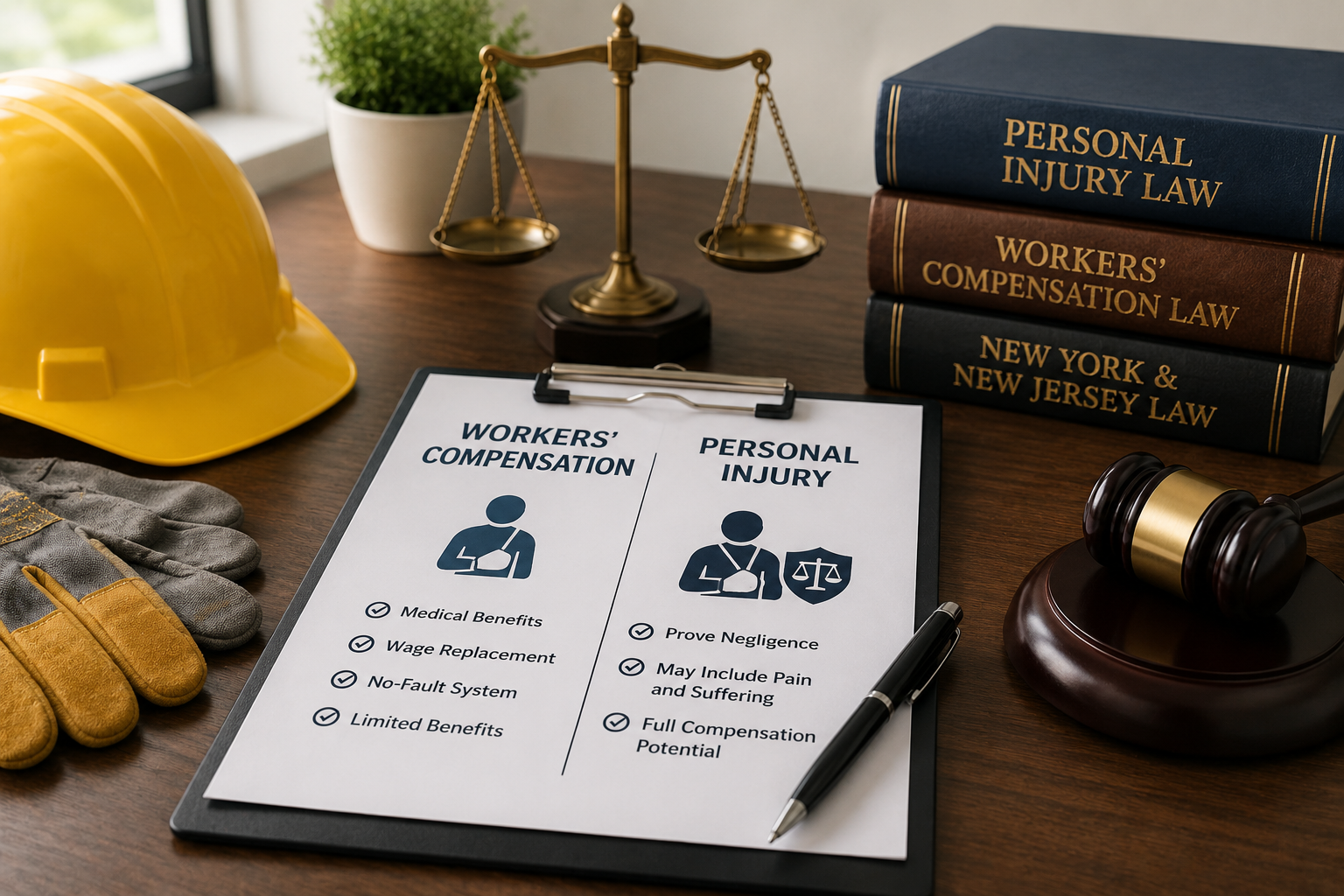
Workers’ Compensation vs. Personal Injury: What’s the Difference?
Workplace accidents happen every day across New York and New Jersey. After an injury, many people assume that Workers’ Compensation is their only option. Others believe they can always file a lawsuit against their employer. Neither assumption is always correct.
Depending on the facts of a particular accident, an injured worker may have a Workers’ Compensation claim, a personal injury claim against someone other than the employer, or, in certain situations, both.
Understanding the differences between these legal processes may help injured workers better understand their rights and the questions they should discuss with an attorney.
IMPORTANT LEGAL NOTICE: This article provides general educational information only and is not legal advice. It does not evaluate any individual’s injury, legal rights, eligibility for benefits, liability, damages, or potential recovery. Reading this article, contacting Pagán López Law, or requesting a consultation does not create an attorney-client relationship.
What Is Workers’ Compensation?
Workers’ Compensation is a state-created insurance system that may provide certain benefits to employees who suffer work-related injuries or occupational illnesses, regardless of who caused the accident.
Depending on the applicable state law and the facts of the case, available benefits may include:
- Medical treatment for covered injuries
- Partial replacement of lost wages during periods of disability
- Permanent disability benefits in qualifying cases
- Vocational rehabilitation or retraining in certain circumstances
- Death benefits for eligible surviving family members when applicable
Workers’ Compensation laws differ from state to state, and eligibility requirements vary depending on the circumstances of the injury.
What Is a Personal Injury Claim?
A personal injury claim is different from a Workers’ Compensation claim.
Instead of seeking statutory Workers’ Compensation benefits, a personal injury claim generally seeks compensation from a person or entity whose alleged negligence or wrongful conduct caused the injury.
Depending on the applicable law and the facts of the case, compensation in a personal injury action may include damages for:
- Medical expenses
- Lost income or diminished earning capacity
- Pain and suffering where permitted by law
- Future medical care
- Other legally recoverable damages
Unlike Workers’ Compensation claims, personal injury cases generally require proof of legal liability.
Can Someone Have Both Types of Claims?
In some situations, yes.
Although Workers’ Compensation generally limits lawsuits against an employer, an injured worker may also have a separate personal injury claim if another person or company—not the employer—may have contributed to the accident.
Examples may include situations involving:
- Motor vehicle accidents during work involving another driver’s alleged negligence
- Defective machinery or equipment manufactured by another company
- Unsafe property conditions owned or controlled by someone other than the employer
- Contractors or subcontractors whose actions may have contributed to the accident
Whether both claims are available depends entirely on the specific facts and applicable law.
What Is the Difference Between Workers’ Compensation and Personal Injury?
Workers’ Compensation
- Usually does not require proving employer negligence
- Benefits are generally established by statute
- May provide medical treatment and wage replacement
- Pain and suffering damages are generally not available under Workers’ Compensation laws
Personal Injury
- Generally requires proof that another party is legally responsible
- Damages vary depending on the evidence and applicable law
- May allow recovery for categories of damages not available through Workers’ Compensation, where permitted by law
These are general principles and should not be interpreted as applying to any specific situation.
How Can Someone Know Which Claim Applies?
Determining whether an injured worker has a Workers’ Compensation claim, a personal injury claim, both, or neither often requires careful factual and legal analysis.
Relevant questions may include:
- Where did the accident occur?
- Was the individual acting within the scope of employment?
- Who owned or controlled the property?
- Was another driver involved?
- Did defective equipment contribute to the injury?
- Were contractors or third parties involved?
- Which state’s laws apply?
The answers to these and other questions may affect the legal options available.
Common Misunderstandings
“I Can Always Sue My Employer.”
Not necessarily.
Workers’ Compensation laws often provide the exclusive remedy against an employer for covered workplace injuries, although exceptions may exist under certain circumstances.
“Workers’ Compensation Pays for Everything.”
Not necessarily.
Available benefits depend on applicable law, medical evidence, eligibility requirements, and numerous case-specific factors.
“If I Receive Workers’ Compensation, I Cannot Have Any Other Claim.”
Not necessarily.
In some situations, a separate claim against a legally responsible third party may also exist.
Whether such a claim exists depends on the specific facts and applicable law.
What Should Someone Do After a Workplace Injury?
Every situation is different, but individuals may wish to consider:
- Reporting the accident as required by applicable workplace policies or law
- Seeking appropriate medical evaluation and treatment
- Preserving photographs, documents, and other available evidence
- Keeping copies of medical records and accident-related documents
- Consulting an attorney to evaluate the specific facts of the case
The appropriate steps depend on the circumstances of each accident.
Frequently Asked Questions
Can I have both a Workers’ Compensation claim and a Personal Injury claim?
In some situations, yes. This may happen when a third party, such as another driver, contractor, property owner, or equipment manufacturer, may have contributed to the workplace injury.
Can I sue my employer after a workplace injury?
Workers’ Compensation laws often limit lawsuits directly against an employer for covered workplace injuries. However, exceptions may exist depending on applicable law and the facts of the case.
Is Workers’ Compensation the same as a lawsuit?
No. Workers’ Compensation is generally an administrative benefits system, while a personal injury lawsuit usually requires proof that another party was legally responsible for causing the injury.
Can I recover pain and suffering through Workers’ Compensation?
Pain and suffering damages are generally not available through Workers’ Compensation. They may be available in certain personal injury claims where permitted by law.
Should I speak with an attorney after a workplace injury?
Speaking with an attorney may help clarify whether Workers’ Compensation, a personal injury claim, or another legal option may apply to your specific situation.
Scope of This Article
This article provides general educational information regarding Workers’ Compensation and personal injury claims.
It does not provide legal advice regarding:
- Specific Workers’ Compensation eligibility
- Personal injury litigation strategy
- Employment law claims
- OSHA investigations
- Disability benefits
- Social Security Disability
- Appeals
- Settlement valuation
- Tax consequences
- Any other legal matter not specifically discussed
Important Warning
Only a licensed attorney can provide legal advice regarding workplace injury claims.
Do not rely on general internet articles, social media posts, or non-lawyers to determine your legal rights.
Final Thoughts
Many injured workers assume they have only one legal option after a workplace accident. In reality, the legal issues may be more complex.
Understanding the general differences between Workers’ Compensation and personal injury claims may help individuals ask informed questions and better understand the legal process.
Every accident is unique. Legal rights, available claims, and potential remedies depend on the specific facts, applicable law, and available evidence.
CONFIDENTIALITY NOTICE
Please do not send confidential or sensitive information by email, text message (including WhatsApp), website forms, or social media until an attorney-client relationship has been established through a written agreement.
Communications before representation may not be protected by the attorney-client privilege.
FREE INITIAL CONSULTATION
Pagán López Law offers a free initial consultation to review the facts of your situation, explain the legal process, and discuss potential legal options where appropriate.
The consultation does not create an attorney-client relationship unless a written representation agreement is executed.
There is no obligation to retain the firm following the consultation.
Prior results do not guarantee a similar outcome. Every case depends on its own facts and applicable law.
Licensed to practice in New York and New Jersey
Pagán López Law – Office HQ
96-04 Northern Boulevard, Corona NY, 11368
Phone: (646) 216-8881
WhatsApp: (347) 434-3041
Email: info@paganlopezlaw.com
ATTORNEY ADVERTISING